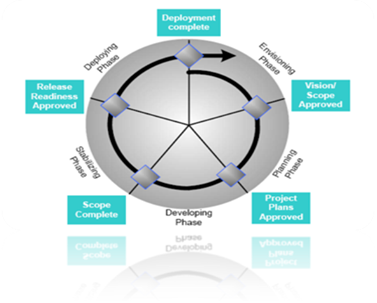

Our Approach
- Envisioning Phase
The envisioning phase addresses one of the most fundamental requirements for project success—unification of the project team behind a common vision. The team must have a clear vision of what it wants to accomplish for the customer and be able to state it in terms that will motivate the entire team and the customer. Envisioning, by creating a high-level view of the project’s goals and constraints, can serve as an early form of planning; it sets the stage for the more formal planning process that will take place during the project’s planning phase.
- Planning Phase
The planning phase is when the bulk of the planning for the project is completed. During this phase the team prepares the functional specification, works through the design process, and prepares work plans, cost estimates, and schedules for the various deliverables.
- Developing Phase
During the developing phase the team accomplishes most of the building of solution components (documentation as well as product review). However, some development work may continue into the stabilization phase in response to testing. The developing phase involves more than hardware selection. The infrastructure is also developed during this phase and all roles are active in building and testing deliverables.
- Stabilizing Phase
The stabilizing phase conducts testing on a solution whose features are complete. Testing during this phase emphasizes usage and operation under realistic environmental conditions. The team focuses on resolving and triaging (prioritizing) bugs and preparing the solution for release.
MSF avoids the terms “alpha” and “beta” to describe the state of IT projects. These terms are widely used, but are interpreted in too many ways to be meaningful in industry. Teams can use these terms if desired, as long as they are defined clearly and the definitions understood among the team, customer, and stakeholders.
- Deploying Phase
During this phase, the team deploys the core technology and site components, stabilizes the deployment, transitions the project to operations and support, and obtains final customer approval of the project. After the deployment, the team conducts a project review and a customer satisfaction survey.
MSF is a disciplined approach to managing technology projects based on Microsoft internal practices, the experiences of Microsoft Services working with customers and partners, and industry best practices in infrastructure acquisition and project management.
MSF is based on two core models: Team Model and Process Model. MSF has also three major areas:
 Project Management Discipline.
Risk Management Discipline.
Readiness Management Discipline.
Please select the social network you want to share this page with:
We like you too :)
Lorem ipsum dolor sit amet, consectetur adipiscing elit. Donec tincidunt dapibus dui, necimas condimentum ante auctor vitae. Praesent id magna eget libero consequat mollis.